Buying a work truck before Dec. 31: how Section 179 and bonus depreciation work in 2026
The 2026 IRS limits, the placed-in-service deadline that sinks late-December purchases, which pickups and vans dodge the SUV cap, a worked example, and the questions to bring to your CPA.
By Rivet Editorial Team · · 6 min read
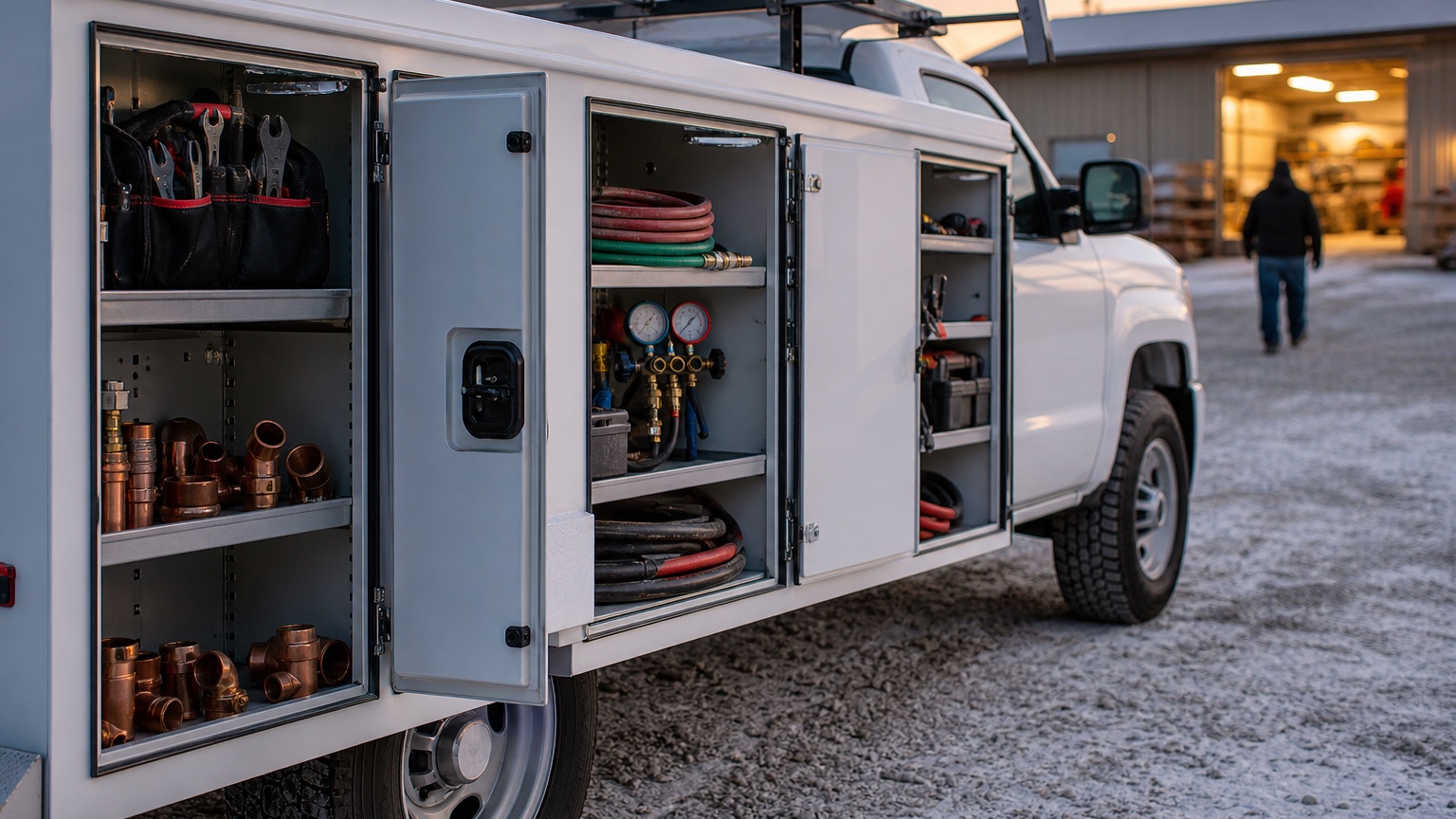
If you buy a service truck, van, jetter or other equipment for the business and it is ready to work by December 31, 2026, you can usually write off the full cost on your 2026 federal return, either through Section 179 or 100% bonus depreciation. If it is still sitting at the upfitter on New Year's Eve, it counts for 2027, not 2026.
That one detail, "placed in service," trips up more year-end purchases than anything else. Below are the 2026 numbers straight from the IRS, the vehicle rules that matter for contractors, a worked example, and the questions to bring to your CPA before you sign anything. This is general information, not tax advice for your shop. Your accountant should run your actual numbers.
The 2026 numbers, from the IRS
The One Big Beautiful Bill Act, signed July 4, 2025, made two big changes. Here is where things stand as of November 2026.
Section 179
Per IRS Revenue Procedure 2025-32, for tax years beginning in 2026:
- Maximum Section 179 deduction: $2,560,000.
- Phase-out starts at $4,090,000 of Section 179 property placed in service during the year. Above that, the limit drops dollar for dollar.
- Heavy SUV cap: $32,000. This is the most Section 179 you can take on one sport utility vehicle (more on which vehicles count below).
For comparison, the 2025 figures were $2,500,000, $4,000,000 and $31,300.
Almost no small shop gets near the phase-out. The limit that actually bites is a different one: per IRS Publication 946, your Section 179 deduction can't exceed your taxable income from the active conduct of your business for the year. Anything over that carries forward to next year.
100% bonus depreciation
IRS Notice 2026-11, issued in January 2026, confirms the law now gives a permanent 100% bonus depreciation deduction for qualified property acquired and placed in service after January 19, 2025. Under the old law, the rate was phasing down to 40% for 2025.
Two fine-print points from the notice:
- The contract date counts. Property is not treated as acquired after January 19, 2025 if you signed a written binding contract for it on or before that date.
- You can choose less. For your first tax year ending after January 19, 2025, you can elect 40% instead of 100%. For most calendar-year shops that was the 2025 tax year, not 2026.
"Placed in service" is the deadline, not the purchase date
Publication 946 says you place property in service when it is "ready and available for a specific use." The IRS's own examples make the point: a machine delivered one year but not installed and running until the next is placed in service in the second year.
What that means at a contractor shop in December:
- Signed the deal Dec 20, truck delivered Jan 6: 2027 deduction.
- Truck delivered Dec 18, still at the upfitter getting shelving and a ladder rack until Jan 10: ask your CPA. If it can't do the job it was bought for until January, the safe reading of the IRS definition is 2027.
- Truck delivered, registered, stocked and running calls Dec 29: 2026.
- Jetter or camera bought Dec 30, on the truck and ready to go Dec 31: 2026, even if it doesn't run a job until January. Publication 946 says property counts once it's ready for its use, even if you aren't using it yet.
What to do: if you're buying in the last three weeks of the year, get a delivery date in writing. Keep the delivery receipt, registration and a dated photo of the finished upfit, then put the vehicle on the dispatch board before the 31st.
Which trucks and vans get the full write-off
This is where the familiar "6,000-pound rule" comes from, and where people get it wrong.
Publication 946 applies the SUV cap ($32,000 for 2026) to a four-wheeled vehicle primarily designed or used to carry passengers with a gross vehicle weight rating over 6,000 pounds and up to 14,000 pounds. The cap does not apply to vehicles that:
- Have a cargo area at least 6 feet long inside, open or covered by a cap. That's a pickup with a 6-foot-plus bed.
- Seat more than nine passengers behind the driver.
- Have an integral enclosure around the driver compartment and load area, with no seating behind the driver's seat. That describes a typical cargo van.
So for a typical trades shop:
- Full-size pickup with a long bed, over 6,000 lb GVWR: generally not subject to the SUV cap.
- Cargo van with no rear seats: generally not subject to the SUV cap.
- Large SUV the owner drives to estimates: the $32,000 Section 179 cap applies. Bonus depreciation is figured separately, so ask your CPA how the two combine.
Check the GVWR yourself. It's printed on the certification label in the driver's door jamb. Don't rely on the salesperson. The weight that counts is the GVWR, not the curb weight.
The 50% business-use rule
Per Publication 946, you can take Section 179 only if the property is used more than 50% for business in the year you put it in service. If business use later drops to 50% or less during the recovery period, part of the deduction is recaptured as ordinary income. A truck that turns into the family vehicle next year can come back to bite you. Keep a mileage log from day one.
A worked example
Here's a hypothetical two-truck HVAC shop. It is an illustration, not a forecast.
- The owner expects about $140,000 of 2026 taxable business income before any new purchases.
- In December the shop buys a $62,000 long-bed pickup with a service body, used 100% for business, plus $9,000 of recovery and vacuum equipment for it. Everything is delivered and on the truck by December 22.
- Total: $71,000, well under the $2,560,000 Section 179 limit and nowhere near the $4,090,000 phase-out.
- The $71,000 is also under the $140,000 business income limit, so the full amount can be expensed on the 2026 return, whether through Section 179, bonus depreciation, or a mix your CPA picks.
What it's worth: a $71,000 deduction doesn't save $71,000. It saves $71,000 times your tax rate. At an illustrative 24% federal bracket, that's about $17,040 less federal income tax. The shop still spent $71,000, so the deduction lowers the real cost of the truck. It doesn't make the truck free.
Now change one thing. Suppose taxable income is only $40,000. Section 179 is capped at $40,000 for the year, and the other $31,000 carries forward. That income limit is a Section 179 rule. Bonus depreciation is a separate deduction with its own rules, so this is exactly when you ask your CPA which method, or mix, fits a lean year.
Should you buy just for the deduction?
Usually not. The deduction moves tax around in time. It doesn't create money. Here's a simple test:
- Would you buy this truck or tool in the next six months anyway? If yes, buying in December mostly pulls the deduction into 2026. That can be smart in a strong year.
- Can you put it to work? A third truck with no third tech to drive it costs payments, insurance and registration whether or not it saved tax.
- Is cash the constraint? Writing off a truck you financed doesn't put cash back in the bank this month. Run the payment against your cash flow in your slowest months, not your busiest.
- Is this a strong year or a weak one? A deduction is worth more in a year you're in a higher bracket. Your CPA may tell you to spread it out.
Questions to bring to your CPA this month
Book the meeting before December 15 so there's time to act. Bring last year's return, a year-to-date P&L and the quotes for what you're thinking about buying.
- What's my projected 2026 taxable business income, and how much deduction can I actually use?
- For this vehicle, Section 179, bonus depreciation, or regular depreciation, and why?
- Does my state follow the federal rules for Section 179 and bonus depreciation?
- If I finance it, what changes for me, if anything?
- Should I hold some of the deduction for 2027 if I expect a better year?
- What paperwork do you want from me to show the date it was placed in service and its business use?
Sources and dates
All dollar limits above are for tax years beginning in 2026 and come from IRS Revenue Procedure 2025-32. The bonus depreciation rules come from IRS Notice 2026-11 (January 2026). The placed-in-service, business-income, 50% business-use and SUV rules come from IRS Publication 946 (2025 edition, for 2025 returns). Check with your tax pro for any IRS updates after November 2026.
Sources
Keep reading

Winter broken-spring calls: a garage door shop's phone script and cycle-life quote
A word-for-word safety script for "door won't open" calls, the one question that sets up the quote, and the cycle-life math that turns spring options into years of service a homeowner can compare.
Nov 17, 2026 · 8 min read

Holiday lights tripping the GFCI: an electrician's phone script and the fixes worth quoting
Most holiday-light trip calls are a GFCI doing its job. Here is a 90-second phone script with red flags, an on-site checklist built on the NEC outdoor receptacle rules, and the three fixes to quote.
Nov 21, 2026 · 8 min read

CO alarm calls: what your CSR should say in the first minute, and what the tech checks after
A word-for-word phone script for carbon monoxide alarm calls, a fast way to tell an alarm from a low-battery chirp, and the whole-house checklist your tech should run once the fire department clears the home.
Nov 21, 2026 · 7 min read