Ice dam calls: a roofing shop's phone script, insurance talk and the fix to quote after the thaw
Sort every ice dam call into one of three jobs in the first minute, tell callers honestly what insurance usually covers, and turn this winter's emergency visits into air-sealing, ventilation and ice-barrier work.
By Rivet Editorial Team · · 8 min read
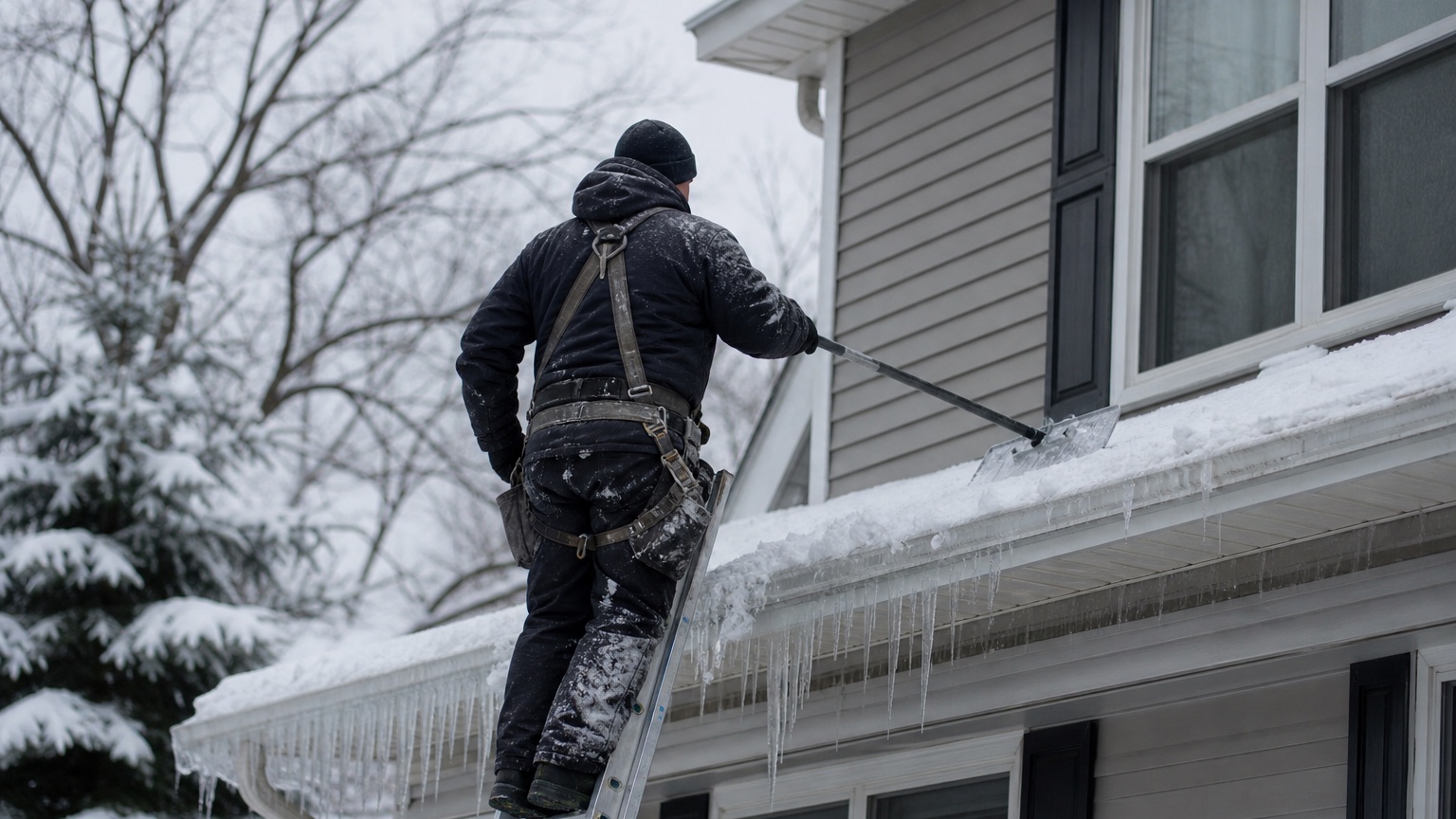
When a homeowner calls about an ice dam, sort the call into one of three jobs before you quote anything: water is coming inside right now (book today), there's a dam but no leak yet (book this week, offer snow removal), or this happens every winter (book a daytime inspection and talk about the real fix). Then set expectations on two points most callers get wrong: clearing the ice is a short-term fix, and their insurance probably won't pay for it.
Below is a phone script for each case, what to tell callers about insurance, and how to turn this winter's emergency calls into next spring's reroof and attic work.
Why ice dam calls bunch up
Ice dams need a specific mix of conditions. University of Minnesota Extension says there must be snow on the roof, the higher parts of the roof surface must be above 32°F while the lower edges stay below freezing, and it has to stay that way for a while. Heat leaking out of the house, mostly warm air escaping into the attic, is what usually warms the upper roof.
So the calls don't come with the first flurry. They come after a solid snowfall followed by a cold stretch, and leaks often show up when it warms a little and the meltwater backs up behind the ice. Expect a cluster of calls a few days after each big storm, not one steady stream.
The building scientists at the Department of Energy's Building America Solution Center (run by Pacific Northwest National Laboratory) say ice dams are "typically prevalent where the ground snow load is greater than 60 lb/ft²" and likely anywhere it's above 30 lb/ft². If your service area is in that range, plan for this every winter.
Sort the call in the first minute
Whoever answers needs four answers before passing the call on or booking:
- Is water coming inside right now? Where: ceiling, wall, around a window, in the attic?
- How much? A stain that's growing, a drip, or a steady stream?
- Is there water near light fixtures, outlets or the electrical panel?
- Has this happened before at this house?
Then route it.
Case 1: Active leak inside
"Thanks for calling. It sounds like ice on your roof is backing water into the house. First, if water is near any light fixtures or outlets, stay clear of them, and shut off that circuit at the panel if you can do it safely. Put towels and a bucket down and move anything valuable out of the way. Take photos of the inside and the roof edge from the ground. We'll get someone out today to relieve the dam so the water can drain. I want to be upfront: that stops the leak for now, but the ice can come back. Once things dry out we'll look at why it's happening."
Book it as a same-day or next-morning priority. Get the address, the pitch if they know it (or "one story or two?"), whether the roof is shingle or metal, and the best callback number.
Case 2: Dam but no leak yet
"Good that you caught it early. The main thing is to get the snow off the lower part of the roof so meltwater can't pool behind the ice. If you rake it yourself, stay on the ground, use a roof rake, and stay well away from where the power lines come into the house. Don't climb up or chip at the ice. You'll damage the shingles. If you'd rather we handle it, I can get you on the schedule this week."
Extension and the Insurance Institute for Business & Home Safety (IBHS) both recommend raking snow off the roof from the ground. IBHS suggests a rake with wheels, which "keep the blade of the rake above the roof cover to minimize scraping," and warns to stay away from where power lines come into the home. Extension adds that even raking "may damage the roofing materials," and says anyone working on a winter roof risks injury, which is a good reason to hire a pro.
Case 3: It happens every year
"If you get ice dams every winter, the ice is a symptom. Heat from the house is getting into the attic and melting the snow from underneath. Let's get the immediate problem handled, then I'd like to book a daytime visit to look at the attic and the eaves so we can tell you what would actually stop it."
This is the call worth the most to your shop over the long run. Don't let it end at "we'll knock the ice off."
What to tell callers about insurance
Callers will ask whether insurance pays. Your team should never promise coverage, but they can tell people how it usually works and send them to their own policy.
Progressive's homeowners guidance sums up the usual pattern:
- The damage may be covered. "Dwelling coverage on a homeowners policy may pay to repair ice dam damage," generally when the damage is sudden and accidental.
- The removal usually is not. "Homeowners insurance typically won't cover the removal of an ice dam."
- Neglect is excluded. "Damage that occurs over time from a lack of maintenance before or after an ice-related event likely won't be covered."
A script your office can use:
"Every policy is different, so please call your insurance company. In general, insurers may cover water damage inside the house but usually don't pay to remove the ice itself. Photos from today will help your claim, and we'll give you a written description of what we found and what we did."
That last part matters. A dated, written job note with photos of the dam, the eave and the inside damage is cheap for you to produce and useful to the homeowner. It also sets your shop apart from the crew that showed up, chipped ice and left.
A practical note from Extension to pass along: "Do not repair interior damage until ceilings and walls are dry." If you also do interior repair, or refer it out, schedule it after things dry, not the same week.
The emergency visit: relieve the dam, don't wreck the roof
On site, the goal is to get water draining without damaging the roof.
- Clear snow from the lower roof first so there's less meltwater feeding the dam.
- Open a drainage channel through the dam rather than trying to remove all of it. Extension describes using tap water on a warmer day to melt a channel, working upward from the lower edge, and is clear that it "will become ineffective within days and is only a temporary solution."
- No hatchets, chisels or rock salt on shingles. You'll be the one blamed for the torn tabs, and Extension already warns that even raking can damage roofing.
- Photograph everything before and after for the homeowner's claim and your records.
If the customer asks about heat cable, IBHS's view is helpful: professionally installed cable on the eaves, gutters and downspouts "won't remove an ice dam, but [it] will create effective channels that allow water to drain off safely." IBHS recommends cable that is UL Listed, FM Approved or CSA Certified. Pitch it as a way to manage a problem roof, not a cure.
The real fix: what to quote after the thaw
The repeat-customer call (Case 3) is where you should spend your estimator's time. The fixes fall into three buckets. You may do some of them yourself and refer out the others.
1. Stop the heat: air sealing and insulation
Every source here agrees on the order. Extension says to seal the air leaks into the attic first, starting with the ceiling, and then add insulation. The Building America Solution Center calls air leaking from the living space the biggest single cause. Its numbers are useful on an estimate:
- In climate zones 5 and up, it recommends R-60 or more for vented attics.
- Insulation over the wall top plates should at least exceed the R-value of the exterior walls, which is often where the eave is starved.
- Leave at least 2 inches of clear air space between insulation and roof deck at the eaves. The IRC minimum is 1 inch, but the guide says a 2-inch gap "is more effective at preventing ice dams."
Extension suggests a weatherization contractor run a blower-door test, possibly with an infrared scan, to find the leaks. If you don't do that work, build a referral relationship with an insulation or energy-audit contractor. It makes your recommendation believable, and they'll send you roofing jobs.
2. Balance the ventilation
The Solution Center calls for balanced intake and exhaust: every rafter bay vented at the soffit, a ridge vent at the top, and baffles to keep the air channel open. It cites IRC 2018 R806.2 for putting 40% to 50% of the required vent area in the upper part of the attic.
One warning to share with homeowners: Extension says powered attic ventilation is not recommended as an ice dam fix, because it can create moisture problems and pull air out of the house. If a customer asks about adding an attic fan, that's your answer.
3. Protect the eave on the next reroof
Where it's adopted, the International Residential Code (R905.1.2 in the 2018 edition) requires an ice barrier that runs "from the lowest edges of all roof surfaces to a point not less than 24 inches inside the exterior wall line of the building."
That 24 inches is measured horizontally, not up the slope, and people underestimate it. In Fine Homebuilding, builder Mike Guertin worked the numbers for a 12-inch overhang and a 2x6 wall: the membrane needs to reach about 47 inches up the slope from the drip edge on a 6/12 roof, 50½ inches on an 8/12, and about 59⅜ inches on a 12/12. All three are more than one 36-inch roll. On a house that already gets ice dams, one course at the eave is not enough.
The Solution Center adds that self-adhering membrane is standard at valleys, dormers and chimneys in ice-dam country, and that in severe areas some builders cover the whole roof. Code editions and local amendments vary, so check what your jurisdiction has adopted before you write it into a bid.
A one-page checklist for your office this winter
- Phone script for the three cases printed at every desk and in the after-hours handoff
- Intake questions: inside water? how much? near electrical? happened before?
- Same-day slots held back on the two or three days after each big snow
- Wheeled roof rakes and channel-cutting gear on the trucks, no chisels
- Before/after photo standard and a written job note template for insurance
- An "every winter" tag in your CRM so Case 3 callers get a spring follow-up
- A referral partner for air sealing and insulation if you don't do it in-house
Ice dam leaks don't wait for business hours. Many get noticed at night or on a weekend, when water appears on a bedroom ceiling, and a caller who reaches voicemail usually keeps dialing until another shop picks up. Make sure someone, or something, answers: an on-call rotation, an answering service, or an AI receptionist such as Rivet, which answers 24/7, tells callers it is an AI, books the job onto your calendar and sends you the summary. Whatever you use, give it the three-case script above so the after-hours call gets sorted the same way the daytime one does.
Sources
- Dealing with and preventing ice dams — University of Minnesota Extension
- Construct roofs and attics for ice dam prevention — Building America Solution Center (DOE/PNNL)
- IBHS offers guidelines to help you stop ice dams — Insurance Institute for Business & Home Safety
- Does homeowners insurance cover ice damage? — Progressive
- Ice-dam protection: how far up the roof slope? — Fine Homebuilding
Keep reading
Holiday lights tripping the GFCI: an electrician's phone script and the fixes worth quoting
Most holiday-light trip calls are a GFCI doing its job. Here is a 90-second phone script with red flags, an on-site checklist built on the NEC outdoor receptacle rules, and the three fixes to quote.
Nov 21, 2026 · 8 min read
Brown Friday 2026: a drain shop's phone and dispatch plan for the day after Thanksgiving
The day after Thanksgiving brings about 50% more drain calls than a normal Friday. Here's the staffing math, a five-question triage script, a disposal-jam talk-through and the pre-holiday customer message to send this week.
Nov 16, 2026 · 8 min read
Winter outage calls: a triage and safety playbook for electrical contractors
When a storm takes the grid down, your phones fill with emergencies, broken generators and install leads at once. Here is how to sort them in 30 seconds, the CPSC-based safety script to read on every call, and what to set up before the first storm.
Nov 13, 2026 · 6 min read