Winter outage calls: a triage and safety playbook for electrical contractors
When a storm takes the grid down, your phones fill with emergencies, broken generators and install leads at once. Here is how to sort them in 30 seconds, the CPSC-based safety script to read on every call, and what to set up before the first storm.
By Rivet Editorial Team · · 6 min read
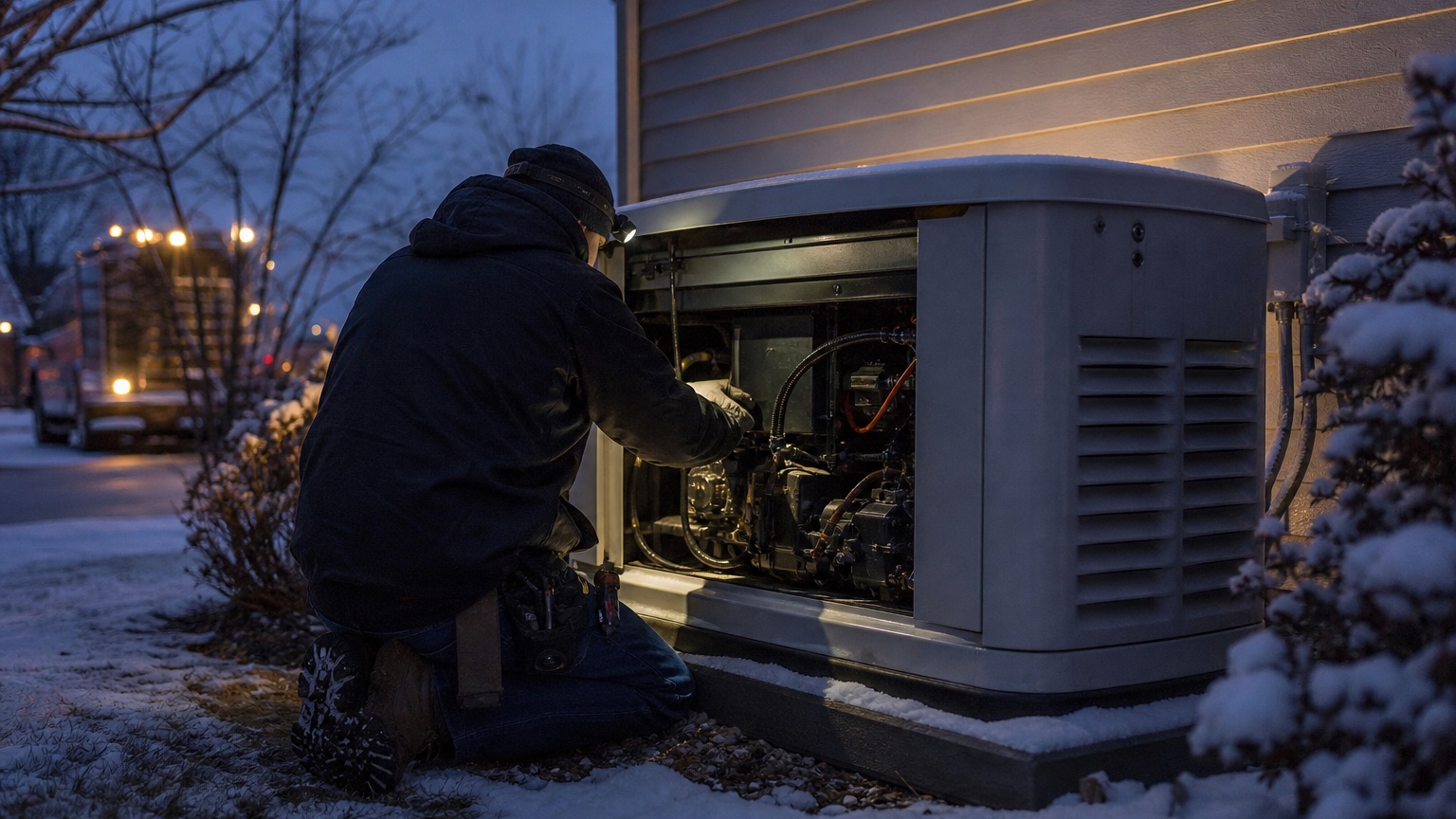
When a winter storm knocks the grid out, an electrical shop gets three kinds of calls at once: people in danger, people with a broken generator, and people who want one installed now. The shops that come out ahead sort those calls in the first 30 seconds, give the safety answer on every call, and book the install leads for after the storm instead of losing them.
This playbook covers the triage questions, the safety script your office should read word for word, how to handle the "can you install one tomorrow" caller, and what to have ready before the first storm of the season.
Why outage calls are getting bigger, not smaller
The numbers from the federal government point one way. According to the U.S. Energy Information Administration, the average U.S. electricity customer went without power for about 11 hours in 2024, the most in 10 years and nearly twice the annual average of a decade earlier.
Almost all of that came from big storms. EIA says major events accounted for nearly 9 hours per customer in 2024, compared with nearly 4 hours a year from 2014 to 2023, and made up 80% of all hours without power. Ordinary outages, the kind without a major event, held at about 2 hours a year.
What that means for your phones: outage demand is lumpy. Most weeks are quiet, then one storm produces a week of calls. The region matters too. EIA reports South Carolina customers averaged nearly 53 hours without power in 2024, while Arizona, South Dakota, North Dakota and Massachusetts averaged under 2 hours.
So the goal is not to staff for storms all winter. It is to have a plan you can switch on the morning the forecast turns.
Sort every outage call into one of four buckets
Train whoever answers the phone, including you at 11 p.m., to put each call into a bucket before talking price or schedule.
1. Danger now
Signs: the caller mentions a generator running in a garage, basement or porch; someone feels dizzy, sick or sleepy; a CO alarm is sounding; there is smoke, sparking, a burning smell, or a line down on the property.
Action: do not book anything. Tell them to get everyone outside into fresh air and call 911. Downed lines go to 911 and the utility, not to your truck.
2. Backfeed risk
Signs: the caller says something like "I plugged the generator into a dryer outlet," "I made a cord with two male ends," "I just flip the main off and plug in."
Action: tell them to shut the generator off and unplug it until it can be connected properly. This is a real safety call, not a sales call. Utility lines can be energized by backfeed from home generators, which puts line crews at risk, per CDC guidance republished by the International Association of Electrical Inspectors.
3. Existing system down
Signs: they already have a standby generator or a transfer switch or interlock, and it did not start, did not transfer, or keeps tripping.
Action: this is your paying emergency work. Get the brand and model if they know it, whether it is a standby unit or a portable with an inlet, what it is doing (no start, runs but no power, trips), and whether the house is safe to enter. Dispatch by priority: medical equipment at home and no heat first.
4. Wants backup power
Signs: "We've been out two days, how fast can you put one in?"
Action: this is a project lead, not an emergency. Book a site visit or quote appointment for after the storm, and give them the safety script for the portable they are probably about to buy.
The safety script your office reads on every outage call
Keep this on a card by the phone and in your after-hours notes. It takes about 30 seconds and is built on the U.S. Consumer Product Safety Commission's winter generator guidance (as of January 2025):
"Before we schedule anything, one safety note. If you are running a portable generator, keep it outdoors and at least 20 feet from the house, with the exhaust pointed away from the home. Not in the garage, basement, crawlspace or shed, and not on the porch or in the carport. Opening windows or doors is not enough ventilation. If anyone feels dizzy or sick, or a CO alarm goes off, get everyone outside and call 911."
Why bother when the caller just wants a time slot? Because the risk is real and well documented. CPSC says an average of about 100 people die in the U.S. each year from carbon monoxide poisoning from portable generators. Your office may be the only trade voice that caller hears before they fire up a generator at night.
Add one line for bucket 2 callers:
"Please don't plug the generator into a wall outlet or the panel without a proper transfer switch or interlock. It can send power back onto the utility lines. Shut it off and we'll get it connected the right way."
How to handle the "install one tomorrow" caller
Storm week is when backup-power leads are hottest and when you are least able to work them. A few rules that keep those leads from walking:
- Do not quote over the phone. Panel capacity, fuel source, where the unit can sit, and what the customer wants to run all change the job. Book the site visit.
- Give a real date. "We're booking install consults starting the 2nd" beats "we'll call you back." The callback that never comes is how you lose the job to the next shop on Google.
- Capture four things: name, address, best number, and what they need powered during an outage (furnace, well pump, sump, fridge, medical equipment). That last answer is your sizing conversation later.
- Tag it in your system as a backup-power lead with the outage date. A week after power comes back, those customers still remember how cold the house got. Call them then.
Code points to check before you quote
Rules depend on which NEC edition your jurisdiction has adopted, so confirm with your inspector. Two points worth having straight:
- Transfer equipment. The whole point of a transfer switch or interlock is that the generator and the utility can never feed the house at the same time. Which products your inspector accepts, especially panel interlock kits, varies by jurisdiction, so ask before you price one in.
- Outdoor emergency shutdown. For one- and two-family dwellings, the 2023 NEC requires an emergency shutdown device for the generator outside the dwelling at a readily accessible location, in Section 445.19(C), as summarized by EC&M. Cord- and plug-connected portable generators are excluded. In the 2020 edition the same rule sat in 445.18(D).
Get ready before the first storm, not during it
A one-page checklist for the week before the season turns:
- Write the four buckets and the safety script on one sheet. Give it to every person who might answer a call, including whoever covers nights.
- Decide who is on call for bucket 3 emergencies, how they get paid for storm work, and what your after-hours rate is. Publish it the same way every time so nobody improvises a price at midnight.
- List your standby-generator customers with brand, model, and last service date. Call the ones overdue for maintenance now. A unit that fails in the storm is the worst call you will take all winter.
- Stock the common parts for the brands you service, so a no-start does not become a three-day wait.
- Set your voicemail and after-hours message to say what you handle during outages and to tell people with an emergency to call 911.
- Make a backup-power lead list you can call the week after the storm.
The phones are the bottleneck
During a big outage, the shop with the most trucks does not always win. The shop that answers wins: it sorts the dangerous calls out, books the repairs in priority order, and does not let the install leads go to voicemail. If your office cannot cover the phone on storm nights, that is the gap to close first, whether with a second person on call, an answering service, or an AI phone receptionist like Rivet, which answers 24/7, says it is an AI, books jobs onto your calendar and sends you a summary of each call.
Whichever you choose, script it now. The first hard freeze will not wait for you to write it.
Sources
- EIA: Hurricanes in 2024 led to the most hours without power in the United States in 10 years (Dec 2025)
- CPSC: As winter weather impacts millions, CPSC issues safety tips to help families prevent carbon monoxide poisoning and fires (Jan 2025)
- EC&M: NEC requirements for generators (Sept 2023)
- EC&M Code Q&A: Dwelling unit standby generator requirements (2020 NEC)
- IAEI Magazine: Winter electrical safety and generators (CDC)
Keep reading
Holiday lights tripping the GFCI: an electrician's phone script and the fixes worth quoting
Most holiday-light trip calls are a GFCI doing its job. Here is a 90-second phone script with red flags, an on-site checklist built on the NEC outdoor receptacle rules, and the three fixes to quote.
Nov 21, 2026 · 8 min read
Ice dam calls: a roofing shop's phone script, insurance talk and the fix to quote after the thaw
Sort every ice dam call into one of three jobs in the first minute, tell callers honestly what insurance usually covers, and turn this winter's emergency visits into air-sealing, ventilation and ice-barrier work.
Nov 19, 2026 · 8 min read
Brown Friday 2026: a drain shop's phone and dispatch plan for the day after Thanksgiving
The day after Thanksgiving brings about 50% more drain calls than a normal Friday. Here's the staffing math, a five-question triage script, a disposal-jam talk-through and the pre-holiday customer message to send this week.
Nov 16, 2026 · 8 min read