Heat pump "not heating" calls: a phone script that sorts defrost from real failures
Steam, lukewarm vents and "AUX" on the thermostat flood the phones in the first cold snap. Here are six triage questions, what manufacturers say is normal, and the red flags that always mean book a tech.
By Rivet Editorial Team · · 8 min read
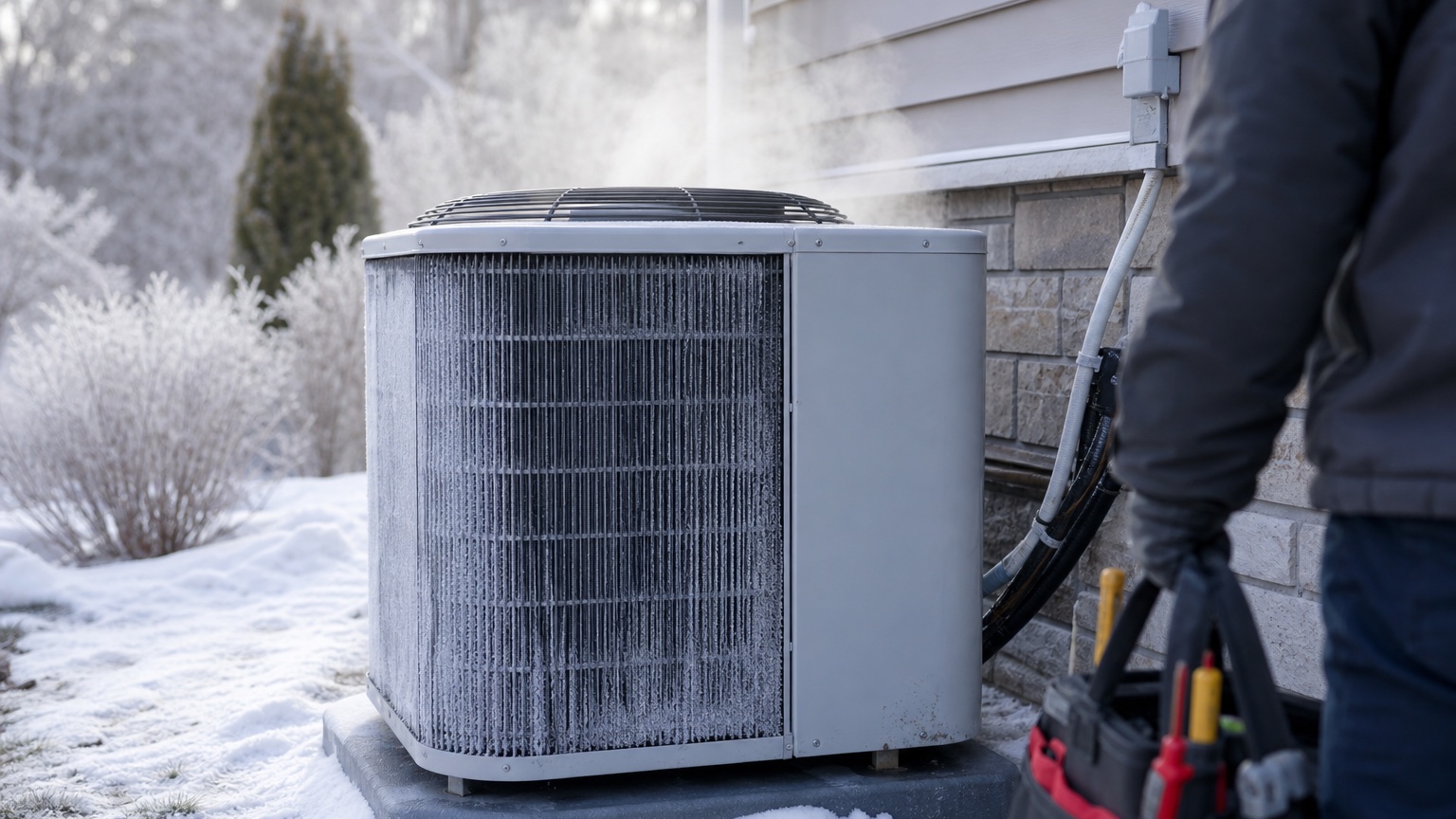
The first cold snap fills the phone with heat-pump calls. A lot of them are not breakdowns. The unit is steaming in the yard during a defrost cycle. The air from the vents feels lukewarm. Or the thermostat says "AUX" and the homeowner thinks something broke.
The fix is a short phone triage your CSR runs the same way every time. Five or six questions sort the call into one of three outcomes: normal operation (coach the customer and log the call), a quick check the homeowner can safely do (then call back), or a real problem (book it now). Below is what the manufacturers say is normal, the script itself, and the warning signs that always mean "send a tech."
One ground rule: this is triage, not diagnosis. If the answers don't fit cleanly, or the customer is worried, book the visit.
What is normal for a heat pump in cold weather
Your CSRs need these facts down cold, because they cover most of the "it's broken" calls in the first freeze. Every figure below comes from manufacturer or Department of Energy material.
Defrost: steam, a whoosh and a short pause in warm air
- It's built in. When it's below freezing, the outdoor coil frosts over and the unit clears the ice on its own, according to a heat pump owner's guide from the Consortium for Energy Efficiency hosted on energy.gov.
- How often. Lennox says most systems check for frost every 30 to 90 minutes in heating mode, and more often on cold, damp days.
- How long. Lennox puts a cycle at 5 to 15 minutes. Carrier's troubleshooting page says about 5 to 10. Exact timing varies by brand and model.
- What the customer sees and hears. Lennox lists steam rising from the outdoor unit and a whooshing sound as the system switches modes. Both are normal.
- What they feel inside. Lennox says warm air pauses briefly and the room may cool slightly. On ducted systems, backup heat may come on during defrost to cover the gap. On ductless systems, the indoor head may blow some cool air while it heats the outdoor coil (CEE/energy.gov guide).
- Meltwater. Defrost water drips at the outdoor unit. The energy.gov-hosted guide warns it shouldn't pool and refreeze on a walkway. That's a slip hazard worth mentioning to the customer.
"The air feels cold" when it is actually heating
Carrier says heat pump supply air typically runs about 85–100°F in heating, compared with roughly 120–140°F from a gas furnace. Lennox notes that vent air can feel cooler than a furnace's even when the system is working properly. A customer who just switched from gas will hold a hand to the register and think it's broken.
The better test is the house, not the hand. Is it holding the temperature on the thermostat?
What "AUX" on the thermostat means
- Auxiliary heat runs on its own. Carrier describes it as a backup heat source built into the system. It turns on below the system's balance point, during defrost, and when someone raises the thermostat by more than 2–3 degrees at once. Trane gives 3–4 degrees, and says aux heat may also come on below about 40°F outdoors or below a set trigger temperature.
- It costs more to run. Carrier says electric auxiliary heat is 100% efficient, while a heat pump can be about 300% efficient. That's why aux heat should only run when needed.
- Emergency heat is different. It's a manual setting that shuts the heat pump off and runs only the backup heat. Carrier says to use it only if the heat pump has physically broken down. Trane says to use it only in a true emergency and to call for service right away if you do.
The six-question phone script
Have the CSR read this word for word until they know it by heart. It takes about three minutes.
1. "Is the house holding the temperature on the thermostat, or is it getting colder?" If it's holding the setpoint, this is almost certainly a comfort question, not a failure. If the house keeps losing temperature, skip to booking (see the red flags below).
2. "What does the thermostat say right now: Heat, Cool, Auto, Emergency, and is the fan set to On or Auto?" Carrier's first troubleshooting step is to check that the thermostat isn't set to cool or constant fan. Lennox says a fan left on "On" pushes air through the vents that isn't warm. If it's set to Emergency, ask who changed it and why. Then go to the emergency heat talk below.
3. "Go look at the outdoor unit if it's safe. Is it steaming, and is there ice on it? About how thick?" Steam with light frost is defrost. Carrier treats frost under about 1/4 inch as normal. Ice thicker than that, or ice still there after defrost ends, is not normal.
4. "Is snow, a drift or a tarp blocking the outdoor unit, or is roof water dripping on it?" Carrier recommends keeping at least 24 inches of clear space around the outdoor unit. The energy.gov-hosted guide warns that units under a roof's drip line can have snow and water problems that block airflow.
5. "When did you last change the filter?" Lennox says a clogged filter restricts airflow and recommends changing it every 1 to 3 months, more often with pets or allergies.
6. "Have any breakers tripped?" Carrier says a tripped breaker can be reset, but if it keeps tripping, call a professional. Tell the customer to reset it once, then call back if it trips again.
Book it now: the red flags
If any of these come up, stop coaching and get a tech scheduled. Each one is from manufacturer or DOE-hosted guidance.
- The house can't reach or hold the setpoint. This is listed as a warning sign in the energy.gov-hosted CEE guide.
- Ice thicker than about 1/4 inch, or ice still there after defrost (Carrier).
- The unit stays in defrost without clearing. Trane says if it's still running and hasn't defrosted after an hour, you may need to call for repair.
- Very frequent or very long defrost cycles. Lennox says repeated long defrost cycles should be checked by a pro. Carrier says unusually frequent defrost needs an inspection.
- "AUX" constantly on the thermostat. The CEE guide lists this as a sign something is wrong. Trane says aux heat running when it's above 40°F outside can mean a heat pump or thermostat problem.
- Cooling works but heat doesn't. Carrier flags this as a possible stuck reversing valve, which needs a technician.
- A breaker that trips again after one reset (Carrier).
- Strange smells, excessive noise, a frozen indoor coil, or a sudden jump in the electric bill. All are on the CEE guide's list of signs a heat pump isn't working properly.
- The customer already switched to Emergency heat because the heat pump quit. By both Carrier's and Trane's definitions, that's a service call.
The emergency heat conversation
This is the call that costs customers money if nobody coaches them. Someone sees "AUX," panics, flips the thermostat to Emergency and leaves it there for a week. A suggested script:
"Emergency heat shuts your heat pump off and runs only the backup heat, which costs a lot more to run. If the heat pump is actually working, we'd recommend switching back to regular Heat and letting the system bring in backup heat on its own when it needs it. If the outdoor unit really has stopped, keep Emergency on to stay warm, and let's get a technician out today."
That matches Carrier and Trane: aux heat comes on automatically, and emergency heat is for a heat pump that has actually failed.
Setback and "my bill doubled" calls
The second wave comes when the first winter bill arrives. Three facts help your CSR here, all from the energy.gov-hosted CEE owner's guide:
- Heat pumps run most efficiently with a steady thermostat setting. The guide says to avoid sudden changes of 3°F or more while the home is empty.
- Setbacks usually save energy only when the customer will be gone more than a day.
- A sudden jump in electricity use is listed as the most common sign a heat pump isn't working properly. That one is worth booking.
A customer who drops the thermostat 8 degrees at night and cranks it back up at 6 a.m. may be pulling in aux heat every morning. Carrier says jumps of more than 2–3 degrees can trigger it. Explain the steady-setting advice. If they still see "AUX" running for long stretches in mild weather, book it. Trane suggests looking into it if aux heat stays on for an hour or two when it isn't cold outside.
Make the "normal" calls count
A call that ends in "that's just defrost" isn't wasted. Close it out properly:
- Log it in your CRM with the cause (defrost, airflow feel, thermostat mode, filter) so you can see what your customers get confused about each cold snap.
- Send a text recap of what you explained, so they don't call back at 11 p.m. the next time it steams. Only text customers who have agreed to get texts from you.
- Offer a maintenance visit if the filter was months old or the unit was half buried in snow. Lennox names dirty or blocked coils and clogged filters as common causes of trouble.
- Tell them a time frame. "If it's still blowing cool air after 15 minutes, or ice is building up, call us back and we'll send someone." That covers the longer end of Lennox's normal defrost range.
Keep the script short enough to run at night, too. These calls don't wait for business hours, and a confused homeowner who reaches voicemail during a freeze often calls the next shop on the list. If after-hours coverage is the gap, an AI receptionist like Rivet can answer around the clock, say up front that it's an AI, run your triage questions, put the real failures on your calendar and send you a summary of each call.
Model details vary, so for any unit you know well, add its manual's specifics to your script. And keep the default simple: when in doubt, book the visit.
Sources
- Lennox: Defrost cycle on my heat pump
- Lennox: Heat pump blowing cold air?
- Carrier: Heat pump not heating? Troubleshooting cold air issues
- Carrier: What is auxiliary heat?
- Trane: What is auxiliary heat and how does it affect HVAC performance?
- CEE via U.S. Department of Energy: You installed an air source heat pump. Now what?
Keep reading
CO alarm calls: what your CSR should say in the first minute, and what the tech checks after
A word-for-word phone script for carbon monoxide alarm calls, a fast way to tell an alarm from a low-battery chirp, and the whole-house checklist your tech should run once the fire department clears the home.
Nov 21, 2026 · 7 min read
Winter roof work: a fall and cold-stress safety plan for roofing crews
The OSHA fall rules that still apply in snow, a pre-climb load and hazard check, the wind-chill numbers that matter, cold-stress symptoms every crew lead should know, and a one-page morning checklist for the truck.
Nov 14, 2026 · 8 min read
Holiday lights tripping the GFCI: an electrician's phone script and the fixes worth quoting
Most holiday-light trip calls are a GFCI doing its job. Here is a 90-second phone script with red flags, an on-site checklist built on the NEC outdoor receptacle rules, and the three fixes to quote.
Nov 21, 2026 · 8 min read